Showing posts with label Environment. Show all posts

Tuesday, 9 September 2014

Let's keep feeding the fat man...

At the moment the world economy is like a fat man who keeps being fed. Governments worldwide seem to have one thing at the heart of their economics; the target of economic growth. In another introductory post I will outline some key issues which I'll go further into at a later time.

If we work on the assumption that: 1. resources are finite and 2. world population will stop growing at around 10 billion people (when the birth rate plateaus at 2 children per woman); then it seems hard to understand why every economic action which governments take is to facilitate growth.

The first rule of economics is that human's have infinite wants and needs and that the world has finite resources. The assumption of endless growth therefore relies on an infinite supply of energy. We could give the fat man some green renewable energy to calm his rumbling stomach but that stuff costs money. Large energy corporations don't want to properly invest in it... but what's a couple hundred million when they make billions in profit? The governments know this as well but why would they, in a time of austerity want to lose a lucrative income stream in the form of fuel duty.
It's not as if the oil companies are completely blind to this reality either.

In its energy scenario, Shell outlines two outcomes: Scramble and Blueprints.

Scramble is essentially, as the name suggests a 'scramble' for energy:


  • The focus here by legislators and decision makers is to make their energy supply in the short term secureBilateral agreements see the rise of local development incentives
    • Politicians give into the electoral imperative. They use supply side policy because stunting energy demand and therefore indirectly limiting economic growth is simply too unpopular.
    • Lack of cooperation means that governments aren't united. This leads to a number of local initiatives which aren't effective. 
      • They don't want to damage their economic growth...
    • The bilateral nature of these deals means that there is competition between governments to get good deals with energy companies
    • As a result the resource holders become the rule makers

  • Developing nations scramble for energy to try and 'climb the economic ladder'
    • On the other hand rich countries don't manage their energy plans in an effort to sustain their lifestyles
    • However, economic development globally doesn't change much because of the switch from oil to coal...kind of like switching to KFC when McDonald's closes down


  • All the while there is the same old rhetoric being put out by those in power saying that they need to combat climate change. 
    • The reality is that they wait until supply of these fuels is low until they start to develop policy which addresses demand. 
    • Nothing really happens in terms of environmental regulation until 'major climate events' take place. 
    • This causes volatility in the energy market and a decrease in economic growth (surprise surprise).
In short, governments and economies favour growth over initiatives that actually solve problems.

Blueprint is the opposite is essentially where governments cooperate and form legislation together to combat this insatiable appetite for energy.


Shell have said that of the two, Scramble is the likelier scenario. We must stop offsetting the problem so that we don't go down the route of Scramble. It shows the need for a change in mentality of the law makers to stop with the short sighted aim of economic growth at all costs.


To find out more info about Blueprints and Scramble watch the video:


Or read them for yourself:
Shell Energy Scenario


Sunday, 27 July 2014

What's the deal with TTIP?! (Pt 2)

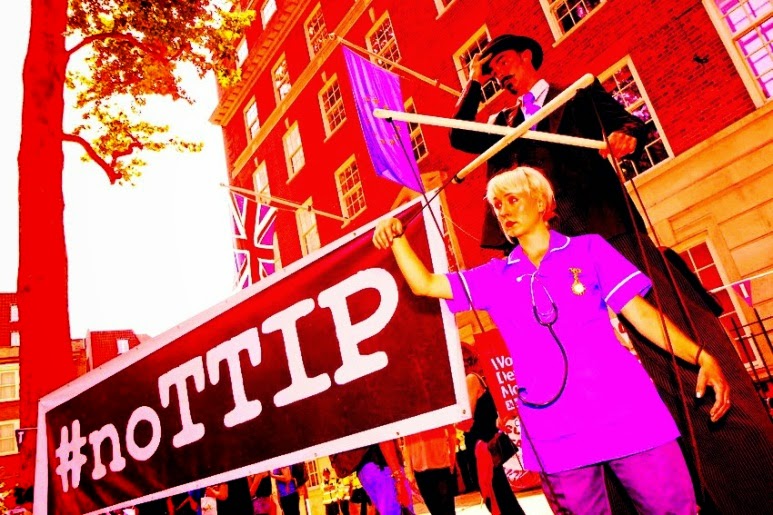
As discussed in the earlier post, which you should read if you already haven't. I'm going to outline only 5 of the many things wrong with TTIP.

1.       Undemocratic

TTIP has been undemocratic since its inception, the whole negotiation process was never meant to be scrutinised publicly with both parties wanting to get this agreement finalised as soon as possible.  It is not ‘transparent’ as has been claimed and it has been confirmed that the European Commission will block any public access to documents about TTIP and has asked MEPs to maintain confidentiality over proceedings. Stateside, Congress won’t be allowed to see draft negotiations; so legislators can’t actually do their jobs because of blocks to their access and the public are unable to scrutinise the treaty for themselves even though it will undoubtedly affect them. The commission are however granting access to businesses. MEP Helmut Scholz writing for EurActiv.com says that ‘the public interest is vastly under-represented’ and that businesses have been given ‘intimate access to EU negotiators’. With the lack of public representation how can this be seen as rule of the people, by the people, for the people-democratic?


2.       ISDS

The Australian government  unveiled plans to standardise cigarette packaging which showed graphic images of the effects of smoking, this will obviously hit the sales and therefore the profits of cigarette companies. The cigarette company then sues the government for billions on account of these lost profits. Well what does this have to do with ISDS and TTIP? This example of what may happen in the near future in the UK and in Europe. This clause would weaken the legislative power of US and EU member states meaning companies could stop legislation going through if it negatively affected them. Plus, these cases would not be brought into court but instead use arbitrators meaning that there is no appeal mechanism for decisions and so no transparency in these dealings. Furthermore arbitrators are much more likely to rule in favour of business as they themselves are corporate lawyers. Some examples of past rulings are:
       Philip Morris vs. Australian government (as described above)
       AbitbibiBowater vs. Canadian government for $122 million over water and timber rights
       Cases against the Argentinian government, many of which were because of the decision to unlink its currency from the US Dollar for  over $500 million
       Vattenfall vs. German government for  €3.7 billion because of Germany’s  decision to stop using nuclear energy  

There are many more examples, but I think you get the gist. This clause in the agreement could be potentially devastating and would definitely hand more power to the businesses.

3.       Threat to Jobs

With the ‘€100 billion’ growth and ‘0.5%’ growth in EU output by 2027 as a result of TTIP you may think that on face value that this means more jobs. In fact free trade deals often result in job losses. Also when looking at our new trading partner we see that operating costs are cheaper which would mean higher unemployment in the EU as more work is outsourced. There is also the fact that trade unions have very limited power meaning work standards are generally lower which is unethical. The EU’s answer to the concern of mass unemployment is for governments to dip into funds set aside for welfare.

4.       Deregulation

When the cat’s away, the mice will play. TTIP would deregulate food safety which includes the use of growth hormones, controlling of harmful substances (e.g., pesticides) and general animal welfare standards. This is because the US has far lower standards than that in the EU; the US has also specified food regulation as a target in TTIP.  This part of the agreement would mean that the EU would be unable to remove food from the market which it suspects is dangerous freely as it does now. At the moment, it is a company’s responsibility to show that its product is safe for consumption, and not the consumer to show that it’s dangerous. However this would be reversed if TTIP is finalised.
Environmental regulations would also be removed with a chance of significant consumption of natural resources and a reduction in biodiversity. There would also be an increase in the amount of CO₂ which would go against the commitments made by the EU in the Kyoto Protocol. Similar to what is described above, safety from chemicals would also be reduced. Currently companies have to show that their chemical is safe before being sold on the market but this could change under TTIP with consumers having to show it is unsafe. An example of this is that only 6/84,000 chemicals are controlled by the US Environmental Protection Agency. 

5.       The NHS (and other public services)


Karel De Gucht, member of the EU Commission is ‘confident’ that the NHS will be exempt from TTIP, but I’m sure Roy Hodgson was also confident he’d win at least one group match at the World Cup. Confidence doesn’t guarantee anything. TTIP would aim to decentralise public services and open them up to the free market, in an effort to break up any government monopolies. It is very likely that TTIP introduces the right to bid on public sector contracts.  Supposing that privatisation did take place, if the government wanted to reverse this later on (remember no Parliament can bind its successor), it would be open to legal action from the private companies which will make a loss from the re-nationalisation. As a result of lobbying from the financial sectors of the UK, US and influential EU member states, TTIP would also remove some of the regulation introduced after the Credit Crunch making the sector prone to another collapse. If public services are privatised it would resemble the US with extortionate hospital and doctor’s bills and lack of access for the average person. 

Check out these links below to find out more:


What's the deal with TTIP?! (Pt 1)

What is TTIP?

The Transatlantic Trade and Investment Partnership (TTIP) is a proposed treaty between the EU and US which effectively creates a single market. If passed it would undoubtedly be the largest free trade deal in history. The treaty itself would cover all areas of the economy including health care, finance and industry. It would dramatically change the way which the EU trades with the US. 

Key features:

1.       Undemocratic
2.       Investor-state dispute settlement (ISDS)
3.       Threat to jobs
4.       Deregulation
5.       NHS (and other public services)


It claims to overcome ‘bureaucratic hurdles’ and help small businesses, instead it would do the opposite. TTIP hands more power to big business and would help US Mega Companies breach the EU market which used to be protected. The EU claims that the following agreement would put ‘€500’ into the pockets of the average EU citizen per year. But, this figure is questionable and has been calculated by dividing the ‘€119 billion’ by the number of citizens in the EU...so whether this agreement would have any positive effects on the average person is still up in the air. TTIP would also deregulate the market meaning that the ‘invisible hand’ would run freely without any interruption from governments.

Read the next blog post to find out more information on those 5 areas.
 
 Check out these links below to find out more: